

INTRODUCTION
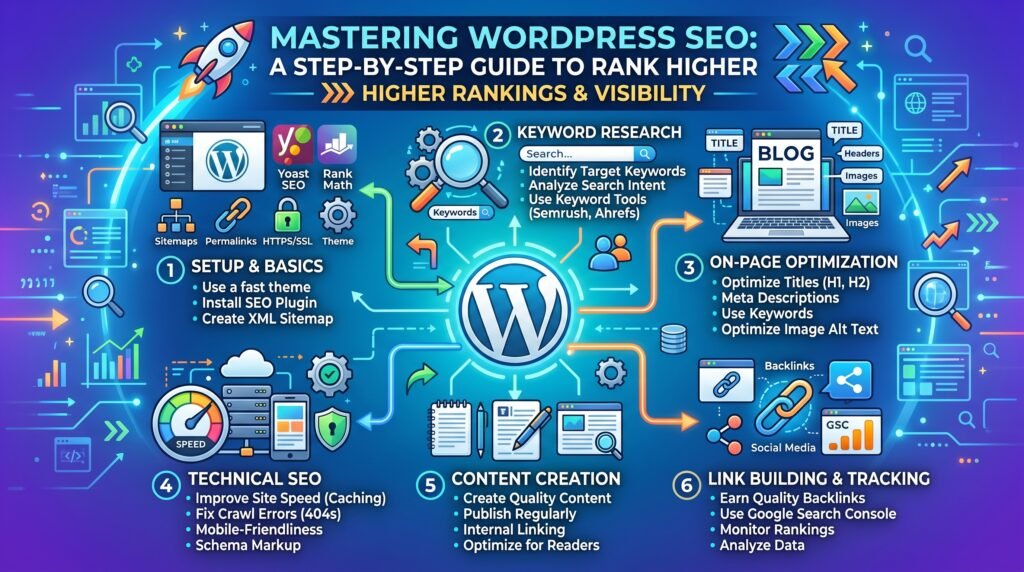
The digital architecture of the internet has undergone a radical transformation by the year 2026, fundamentally altering the mechanisms through which information is categorized, indexed, and retrieved by search algorithms.
In an era dominated by generative search experiences, large language model integrations, and exceptionally strict performance metrics, maintaining absolute technical perfection on a website is no longer an optional advantage—it is a baseline requirement for survival.
The native content management system, while powerful, lacks the granular technical capabilities required to interface effectively with modern search crawlers. Consequently, the deployment of third-party architectural solutions is mandatory.
Evaluating the market of WordPress SEO Plugins requires a rigorous analytical approach, specifically focusing on how these tools manipulate server databases, execute rendering protocols, and generate compliant structured data without imposing catastrophic performance penalties.
This comprehensive report dissects the leading solutions, providing deep technical insights, economic evaluations, and architectural benchmarking to guide digital administrators in their infrastructural investments.
Why WordPress SEO Still Matters in 2026
Search engines are smarter, but competition is harder
The contemporary search landscape is characterized by algorithms that possess near-human semantic comprehension, heavily relying on natural language processing to discern the precise intent behind user queries. While these systems are theoretically capable of parsing unstructured data, the sheer density of digital competition means that algorithmic resources are aggressively rationed. Search engines allocate specific crawl budgets to domains based on their structural efficiency. Websites that force crawlers to navigate infinite redirect loops, process bloated cascading style sheets, or decipher contradictory canonical tags are summarily devalued. Implementing proper WordPress SEO Plugins resolves these deep-seated technical frictions, ensuring that the semantic weight of the content is not suppressed by an underlying foundation of broken code, thereby securing a competitive edge in a hyper-saturated market.
Why beginners struggle with SEO setup
The core difficulty for novice administrators stems from the vast dichotomy between content creation and server-side technical formatting. Modern optimization requires a deep understanding of HTTP response codes, taxonomy indexing directives, and the intricate deployment of JSON-LD nested schemas. The terminology acts as a significant barrier to entry; concepts such as managing pagination arrays, executing wildcard redirects, and optimizing the Time to First Byte (TTFB) are entirely foreign to standard publishers. Without the abstraction layers provided by sophisticated WordPress SEO Plugins, beginners are forced to manually edit .htaccess files or inject raw PHP into theme functions, introducing a critical risk of triggering fatal server errors and entirely erasing their digital footprint from search engine indices.
The role SEO plugins play in modern WordPress websites
Technical optimization tools function as vital translation engines, bridging the gap between human-readable narratives and the rigid, machine-readable syntaxes demanded by search algorithms. By hooking directly into the core application programming interfaces of the content management system, these tools automatically intercept content rendering processes to inject necessary metadata, structure robust XML sitemaps, and establish strict canonical routing protocols. When properly deployed, WordPress SEO Plugins act as an invisible infrastructural shield, proactively preventing the generation of duplicate content pathways that naturally occur within dynamic tagging and categorization systems. This automation allows administrators to allocate their operational resources entirely toward high-fidelity content production rather than engaging in continuous, manual technical maintenance.
What Makes a Good WordPress SEO Plugin for Beginners?
Easy interface vs advanced control
Software architecture for novice administrators must successfully navigate the complex dichotomy between extreme accessibility and necessary technical granularity. Superior solutions utilize intelligent onboarding wizards that automatically deploy baseline best practices—such as establishing sitewide schema types and configuring foundational sitemaps—without paralyzing the user with highly technical decisions. However, as the digital asset scales, the administrator will invariably require access to advanced taxonomy management, custom metadata injection, and specific indexing overrides. The most effective WordPress SEO Plugins provide this sophisticated control matrix within logically nested, unobtrusive menus, ensuring that the interface remains streamlined for daily editorial tasks while preserving the advanced configuration capabilities required for enterprise-level architectural maneuvers.
Speed, compatibility, and automation
Performance optimization is indistinguishable from search optimization in 2026. The integration of any third-party tool inherently introduces a degree of computational overhead, but the variance between market competitors is staggering. Independent benchmarking by Accelera demonstrates that poorly optimized suites can inject over 80 kilobytes of unnecessary CSS and execute more than 100 JavaScript files on a single page, severely degrading core web vitals. Conversely, elite WordPress SEO Plugins utilize modular, object-oriented programming to execute their functions in mere milliseconds. Furthermore, these tools must demonstrate absolute compatibility with modern caching mechanisms and headless front-end deployments, ensuring that the automation of meta-tagging and schema generation does not trigger secondary rendering conflicts.
AI-powered SEO features becoming standard
The utilization of artificial intelligence within the optimization workflow has transitioned from an experimental novelty to a mandatory industry standard. Modern platforms integrate directly with external large language models to provide real-time, algorithmic assistance directly within the native text editor. These systems process billions of historical data points to execute predictive keyword mapping, generate semantically perfect title tag variations, and evaluate the contextual density of the narrative against leading competitors. By shifting the computational burden of competitive analysis to external software-as-a-service infrastructures, modern WordPress SEO Plugins deliver enterprise-grade market intelligence to novice users without compromising the localized performance of the host server.
Common mistakes beginners make while choosing plugins
A pervasive operational error among novice administrators is the conflation of software feature quantity with actual optimization value. This misconception frequently leads to the installation of massive, bloated toolsets containing features—such as integrated analytics dashboards and complex role managers—that are fundamentally unnecessary for standard publishing environments. Furthermore, beginners frequently fall victim to the psychological trap of “green light syndrome,” aggressively altering natural linguistic patterns to satisfy arbitrary, static algorithmic grading systems. The most catastrophic mistake, however, is failing to investigate uninstallation protocols; many low-quality WordPress SEO Plugins permanently pollute the host database with orphaned metadata upon deactivation, creating a permanent layer of technical debt.
1. Yoast SEO — The Most Beginner-Friendly SEO Plugin
Key features that still make Yoast relevant
Yoast established the foundational paradigm for how optimization software interfaces with content creators, and its legacy architecture remains highly relevant for specific use cases. The platform is renowned for its proprietary readability analysis engine, which evaluates syntactic complexity, transition word frequency, and paragraph density to ensure alignment with modern algorithmic preferences for accessible, frictionless content. The complimentary tier continues to provide robust architectural necessities, including seamless breadcrumb navigation mapping, automated extensible markup language sitemaps, and a highly intuitive single-focus keyword optimization parameter. These features are consolidated within a user interface that has defined the standard for WordPress SEO Plugins for over a decade.
Real strengths and limitations in 2026
Despite its historical dominance, empirical performance telemetry reveals severe architectural limitations within the modern digital ecosystem. Independent benchmarks classify Yoast as one of the heaviest optimization tools available, recording a sluggish frontend execution time of 71 milliseconds and loading nearly 50 kilobytes of CSS assets into the document object model. Economically, the premium iteration demands approximately $128 annually for a single site license, yet requires costly, separate compartmentalized add-ons for essential modern features like localized business schema and specialized video indexation. Furthermore, unlike superior WordPress SEO Plugins, it lacks a dedicated uninstallation cleanup protocol, leaving massive volumes of proprietary data permanently embedded in the server architecture after removal.
Best for bloggers and simple business websites
While performance-centric developers actively migrate away from this platform, its psychological design remains highly effective for non-technical bloggers and fundamental digital portfolios. The stoplight-colored scoring matrix provides immediate, unambiguous validation that instills operational confidence in novice authors. For individuals publishing basic narrative content without the necessity of managing complex programmatic taxonomies, the complimentary version supplies a sufficiently stable architectural foundation. Its unparalleled historical adoption rate ensures that nearly every third-party visual builder and caching utility maintains inherent compatibility, minimizing the risk of systemic software conflicts for beginners deploying WordPress SEO Plugins for the first time.
| Metric | Yoast SEO Performance | Industry Standard Comparison |
| Frontend Execution Time | 71 ms | Heavy |
| Dashboard Execution Time | 95 ms | Heavy |
| CSS Footprint | 48.8 KB (14 files) | High |
| JavaScript Footprint | 678 KB (30 files) | High |
| Clean Uninstall Support | No | Lacking |
2. Rank Math — The Smart All-in-One SEO Plugin
Why Rank Math exploded in popularity
Rank Math achieved massive market penetration by systematically analyzing the economic and technical limitations of entrenched legacy platforms and offering advanced functionalities entirely free of charge. By permitting the simultaneous tracking of five distinct focus keywords and including a robust redirection manager within its complimentary tier, it immediately rendered the paid entry tiers of its competitors obsolete. This aggressive market disruption generated immense traction, propelling the parent company to an estimated annual revenue of $2.39 million and a corporate valuation of $7.7 million. This financial stability ensures that the development of their WordPress SEO Plugins remains highly active, continuously pushing the boundaries of what is possible within the native administrative environment.
Built-in schema, AI suggestions, and analytics
The platform differentiates itself through an exceptionally deep integration with modern search protocols. It features an advanced schema mapping architecture that dynamically translates complex custom database fields into pristine JSON-LD structured data outputs, ensuring eligibility for highly coveted rich media snippets. The proprietary Content AI system functions as a real-time editorial consultant, analyzing live search engine results pages to provide highly specific semantic entity recommendations and topical cluster mapping. Additionally, the premium iteration bypasses the need for external data visualization tools by pulling granular impression and position telemetry directly from Google Search Console into the administrative interface, establishing this tool as a premier analytical powerhouse among WordPress SEO Plugins.
Where it beats traditional SEO plugins
When subjected to rigorous economic and technical analysis, Rank Math presents a dramatically superior value proposition compared to traditional market leaders. The premium iteration, priced competitively at roughly $96 annually, inherently includes the localized search configurations and programmatic schema controls that require expensive, disconnected add-ons in other ecosystems. Performance benchmarking validates its technical efficiency, demonstrating a highly respectable frontend execution time of 69 milliseconds while maintaining a massive feature set. For digital agencies managing expansive, high-value client portfolios, the software offers scalable licensing and deep white-label reporting capabilities, solidifying its position as one of the most versatile and computationally efficient WordPress SEO Plugins available.
3. All in One SEO (AIOSEO) — Best for Small Businesses
Setup simplicity and dashboard experience
AIOSEO has been meticulously re-engineered to align seamlessly with the operational realities and technical constraints of small business owners. The onboarding architecture utilizes a highly contextual configuration wizard that automatically deploys complex server directives based on the specific categorization of the business entity. The primary centralized dashboard aggregates complex Google Search Console data—including real-time click-through rates and content decay analysis—into a singular, highly comprehensible interface. Furthermore, the proprietary TruSEO scoring algorithm evaluates over seventy distinct technical parameters instantaneously, providing prescriptive, algorithmic recommendations that differentiate elite WordPress SEO Plugins from standard metadata editors.
Local SEO and WooCommerce optimization
The structural supremacy of this platform is anchored in its highly specialized commercial and geographical modules. The Local SEO configuration interfaces directly with the Google Maps API, automatically structuring business coordinates, operational hours, and multi-location franchise data into perfect localized schema markup without requiring a single line of manual code. For digital retailers, the deep WooCommerce integration dynamically scrapes product specifications, aggregate consumer ratings, and real-time inventory levels, injecting this critical commercial data directly into the search ecosystem. Coupled with an advanced redirection manager that actively monitors the site for 404 errors, these specific WordPress SEO Plugins provide a comprehensive architectural shield for commercial properties.
Who should use AIOSEO in 2026
This comprehensive software is strategically engineered for commercial entities that prioritize immediate revenue generation and operational stability over granular server-side tinkering. The economic model is heavily tiered to accommodate varying scales of operation: the Basic plan ($49.50/year) serves solitary sites, the Plus plan ($99.50/year) targets small businesses, the Pro plan ($199.50/year) accommodates growing digital storefronts, and the Elite plan ($299.50/year) supports expansive agency portfolios of up to 100 properties. However, administrators must acknowledge that this vast feature density introduces substantial computational drag, recording a frontend execution time of 103 milliseconds and loading 82.6 KB of CSS. Consequently, these specific WordPress SEO Plugins are best deployed on highly optimized, premium hosting architectures capable of absorbing the performance tax.
| AIOSEO Plan | Annual Pricing | Site Limit | Key Capabilities |
| Basic | $49.50 | 1 Site | TruSEO, Smart Schema, WooCommerce, 10k AI Credits |
| Plus | $99.50 | 3 Sites | Local SEO, Image SEO, Author E-E-A-T, 25k AI Credits |
| Pro | $199.50 | 10 Sites | Redirection Manager, Link Assistant, 50k AI Credits |
| Elite | $299.50 | 100 Sites | Keyword Rank Tracking, Client Management, 200k AI Credits |
4. SEOPress — Lightweight and Privacy-Friendly SEO Plugin
Why performance-focused users prefer it
SEOPress operates on a philosophical foundation of absolute minimalism, non-intrusive operations, and strict data privacy. In stark contrast to aggressive market alternatives, the software explicitly refuses to inject promotional up-sells into the administrative interface and actively abstains from deploying any user telemetry or data harvesting scripts. This uncompromising commitment to operational purity extends deeply into its underlying architecture; the codebase is exceptionally streamlined, registering a highly efficient 63 millisecond frontend execution time and generating negligible database queries. For purists who demand full ownership of their administrative environment without the constant disruption of gamified notifications, this tool represents the pinnacle of pragmatic WordPress SEO Plugins.
Clean UI without unnecessary distractions
The graphical user interface is distinctively austere, entirely devoid of the colorful algorithmic scoring matrices that characterize consumer-grade competitors. Rather than obscuring complex technical server settings behind opaque onboarding wizards, SEOPress organizes advanced controls—such as custom breadcrumb routing, dynamic social graphing tags, and complex extensible markup language sitemaps—into highly logical, hierarchical menus. This absolute transparency allows experienced administrators to execute granular modifications to the document object model with maximum efficiency. The deliberate omission of artificial readability grading forces the content creator to focus entirely on natural semantic structures, a methodology heavily favored by developers utilizing professional WordPress SEO Plugins.
Best use cases for agencies and creators
The economic paradigm of SEOPress is arguably the most disruptive and agency-friendly in the entire digital ecosystem. The Pro version unlocks the entirety of its advanced architectural feature set—including localized search structures, deep WooCommerce integrations, and automated 404 monitoring—for a flat, highly predictable fee of $49 per year for a single site. For enterprise agencies, the unlimited site license at $149 per year represents an extraordinary economic advantage, allowing for infinite scalability without compounding software overhead. This unique combination of predictable pricing, comprehensive white-label capabilities, and pristine code positions it perfectly for developers who mandate the integration of performance-optimized WordPress SEO Plugins within their standardized deployment stacks.
5. The SEO Framework — Minimal Yet Powerful
Fastest SEO plugin experience for WordPress
Independent telemetry confirms that The SEO Framework (TSF) is categorically the fastest and most computationally efficient optimization suite available in the global market. Recording an astonishing frontend execution time of just 35 milliseconds, a dashboard execution of 6 milliseconds, and loading a microscopic 5.7 KB of cascading style sheets, it operates with virtually undetectable computational overhead. The application requires a memory footprint of roughly 24 KB, making it functionally invisible to server resource monitors and caching utilities. This extreme architectural optimization ensures that critical core web vital scores remain completely pristine, fulfilling the primary technical mandate of high-performance WordPress SEO Plugins.
Automation-focused optimization
TSF categorically rejects the premise of manual, iterative page-by-page metadata engineering, opting instead for a highly sophisticated, programmatic approach to digital architecture. The software dynamically calculates and injects optimal titles and descriptions based on an algorithmic analysis of content density and taxonomy structures. It enforces exceptionally strict canonical regulations, aggressively blocking search crawlers from wasting crawl budget on thin archives, unpopulated category pages, and isolated attachment files. By utilizing proprietary real-time caching protocols, the software proactively reduces database querying, ensuring that search engines prioritize high-value content arrays—a functionality rarely executed properly by standard WordPress SEO Plugins.
Pros and limitations beginners should know
The strict adherence to performance and automation necessitates certain functional compromises that novice administrators must understand prior to deployment. TSF does not include artificial intelligence integrations, readability grading systems, or real-time keyword density analyzers within the primary editorial interface. Furthermore, while the highly capable baseline software is completely free, acquiring advanced localized search data modules or specialized article configurations requires subscription to premium tiers ranging from $7 to $27 per month, billed annually. Despite these omissions, its unassailable status as the performance champion makes it a vital inclusion among WordPress SEO Plugins for administrators who prioritize raw site velocity and automated structural integrity over gamified writing assistance.
6. Squirrly SEO — AI SEO Coaching for Beginners
Real-time optimization assistance
Squirrly SEO entirely redefines the operational paradigm of optimization tools by functioning less as a static technical configuration panel and more as an interactive, algorithmic consultant. The platform integrates a proprietary machine learning engine known as Newton AI, which provides instantaneous, highly specific coaching directives directly within the native WordPress text editor. As the user authors content, the system analyzes the text against billions of historical data points to ensure precise keyword prominence, semantic entity clustering, and contextual relevance. This immediate, algorithmic feedback loop effectively trains novice writers in advanced, data-driven methodologies through active, hands-on application, distinguishing it from traditional WordPress SEO Plugins.
Keyword strategy and content guidance
The software circumvents the need for expensive, external market analysis platforms by embedding a massive keyword intelligence suite directly into the administrative dashboard. It leverages powerful cloud-based processing to bypass local server limitations, offering predictive search volumes, highly accurate competition indexing, and topical gap analysis across over 140 distinct linguistic variations. Unique to its structural architecture is the “Focus Pages” system, which utilizes Ranking Vision AI to assess the entire domain’s health and generates a chronological, daily sequence of actionable tasks prioritizing the highest-impact structural improvements. This level of strategic mapping is rarely found natively within standard WordPress SEO Plugins.
Is it actually useful or just marketing hype?
While technical traditionalists often view gamified optimization systems with skepticism, Squirrly demonstrates highly tangible utility for specific administrative demographics. Because its massive computational tasks are entirely offloaded to external software-as-a-service infrastructure, it completely avoids bogging down the host server’s resources. At a highly accessible $9.99 per month for the Pro iteration, it consolidates strategy, research, and execution into a singular, cohesive workflow. For solitary entrepreneurs or novice marketers who lack the capital resources to hire dedicated agency consultants, the educational framework and rigid strategic mapping provided by these highly specialized WordPress SEO Plugins justify the investment by enforcing consistent, high-quality production habits.
7. Slim SEO — Best Lightweight SEO Plugin for Simplicity
Zero-configuration SEO setup
Slim SEO was explicitly architected as a direct rebellion against the escalating operational complexity and interface bloat that plagues dominant market alternatives. The core philosophy of the software is absolute, frictionless automation; the plugin lacks a traditional settings panel entirely. Upon activation, it immediately initiates optimal technical configurations: auto-generating precise meta tags, structuring robust extensible markup language sitemaps, deploying necessary schema markup, and establishing correct canonical routing without requiring a single user input or decision. From a performance standpoint, it is staggering, executing frontend processes in a remarkable 23 milliseconds and loading only 1.2 KB of assets, making it the most mathematically efficient software among all WordPress SEO Plugins.
Why many creators now prefer minimal plugins
The modern creator economy increasingly views deep technical maintenance and continuous server-side tweaking as a low-return distraction from actual content production. Advanced optimization tools frequently prompt continuous modifications, creating an illusion of progress while actively halting publication velocity. Minimalist architectural design eliminates this friction entirely. By removing intrusive dashboard widgets, complex redirection matrices, and constant promotional notifications, the software allows creators to exist purely within the editorial workflow. Furthermore, the pristine codebase guarantees that software interactions will not trigger catastrophic core web vital failures, a critical assurance when deploying modern WordPress SEO Plugins.
Ideal websites for Slim SEO
This solution is precision-engineered for straightforward publication platforms where narrative content serves as the primary currency and structural complexity is minimal. Standard narrative blogs, digital portfolios, and localized service businesses benefit immensely from its pure “set and forget” methodology. While advanced developers can leverage custom hooks and filters to modify baseline parameters via PHP, the software is inherently unsuited for massive digital storefronts or complex programmatic publishing environments requiring hyper-granular taxonomy controls. For users desiring advanced capabilities—such as schema integration and redirection monitoring—without sacrificing the minimal footprint, the Pro version is available for $59 annually , cementing its status among elite WordPress SEO Plugins.
| Lightweight Plugin Comparison | Frontend Speed | CSS Size | JS Size | Uninstallation Method |
| Slim SEO | 23 ms | 1.2 KB | 16 KB | Clean via constant |
| The SEO Framework | 35 ms | 5.7 KB | 22.4 KB | Clean via filters |
| SEOPress | 63 ms | 14.4 KB | 9.8 KB | No native clean uninstall |
8. WP Meta SEO — Strong Bulk SEO Management Tool
Managing metadata at scale
WP Meta SEO addresses a specific, highly frustrating operational bottleneck that plagues mature websites: the modification of optimization parameters across massive, historical content libraries. Traditional interfaces force administrators to open, edit, and save individual posts iteratively—an agonizing and temporally expensive process when auditing hundreds of pages. This tool introduces a highly robust bulk-editing matrix, allowing users to rapidly update meta titles, descriptions, and canonical parameters from a singular, centralized spreadsheet-style interface. This capability drastically reduces the temporal cost of site-wide optimization audits, demonstrating the unique utility of highly specialized WordPress SEO Plugins when executing comprehensive technical turnarounds.
Image SEO and sitemap management
Beyond the manipulation of textual metadata, the application excels in the structural optimization of rich media assets. It features an intelligent image processor that permits the bulk modification of alternative text, file nomenclature, and title attributes, whilst simultaneously dynamically resizing assets in the HTML to prevent layout shifts and bandwidth waste. Additionally, it engineers both XML and HTML sitemaps with deep customization options, allowing administrators to selectively exclude specific custom post types, tags, or external plugins from the crawler paths. The premium integration automatically synchronizes these complex routing files directly with Google Search Console infrastructure, ensuring immediate indexation—a rare feature among standard WordPress SEO Plugins.
Best for content-heavy websites
Developed by the highly regarded engineering team at JoomUnited, this software is specifically designed to handle the rigorous operational demands of enterprise-level publishing environments. A site housing thousands of historical articles requires the rapid triage and data manipulation capabilities that standard interfaces fundamentally lack. Priced at a highly accessible $49 for the Pro version , the software introduces advanced predictive keyword analytics directly sourced from Google data, facilitating highly intelligent historical content updates. For network administrators tasked with resurrecting poorly maintained, high-volume websites, utilizing specialized WordPress SEO Plugins like WP Meta SEO provides the exact operational leverage necessary for rapid architectural stabilization.
9. Schema Pro — Best Plugin for Rich Snippets and Structured Data
Why schema matters more in Google search now
The visual composition and interactive nature of search engine results pages have evolved far beyond standard blue algorithmic hyperlinks. Modern search algorithms heavily prioritize rich media snippets—including aggregate star ratings, dynamic pricing matrices, event scheduling interfaces, and interactive frequently asked questions. These visual enhancements dramatically increase click-through rates by dominating visual real estate and establishing immediate, unassailable domain authority. Implementing this structured data requires flawlessly translating page information into a complex JSON-LD format. Failure to structure this data correctly results in immediate disqualification from these high-visibility placements, highlighting the necessity of precision-engineered WordPress SEO Plugins.
Rich snippets, FAQs, and product schema
Schema Pro serves as a dedicated, highly automated translation layer strictly for complex structured data. Rather than relying on the rudimentary and often rigid schema output of generalized optimization tools, it provides highly customized mapping capabilities that link advanced custom database fields directly to over twenty distinct schema properties. This integration with Advanced Custom Fields (ACF) allows for the dynamic injection of complex architectures—such as multi-location business markup, detailed recipe configurations, and deep video indexing parameters—across thousands of pages simultaneously. The automation ensures that the output strictly adheres to the constantly evolving syntactical guidelines, an absolute requirement for specialized WordPress SEO Plugins.
Who actually needs Schema Pro
Not every digital property requires dedicated structural software of this magnitude. Administrators utilizing the premium versions of expansive, all-in-one suites often possess sufficient baseline markup for standard publishing. However, for developers operating complex directory sites, review aggregators, or intricate programmatic platforms where granular data representation is the primary value proposition, generalized tools fall critically short. Priced at $79 annually for unlimited domains (or bundled at $249) , it allows developers to maintain a minimalist primary optimization tool while outsourcing the heavy computational lifting of structured data to a highly specialized application, representing a highly sophisticated deployment of WordPress SEO Plugins.
10. Broken Link Checker — The Underrated SEO Maintenance Plugin
Why broken links quietly hurt rankings
Hyperlinks act as the fundamental structural sinew connecting the disparate architectural nodes of the internet. When internal routing fails, it completely severs the flow of link equity between pages, devastating the hierarchical authority of the domain. Furthermore, when search engine crawlers encounter high frequencies of 404 error codes during their traversal, they interpret the domain as neglected or poorly maintained. This specific algorithmic trigger drastically reduces the assigned crawl budget, meaning newly published, high-value content may languish unindexed for weeks. From a user experience perspective, broken navigation destroys trust and exponentially increases bounce rates, sending strong negative behavioral signals that standard WordPress SEO Plugins cannot mitigate.
Automating technical SEO maintenance
Manually auditing the thousands of internal and external hyperlinks embedded within a mature website is an impossible, temporally exhausting logistical task. The Broken Link Checker automates this critical infrastructure maintenance by systematically scanning the entire document object model—including localized text, embedded media, custom fields, and complex redirection chains. With over 17 million downloads and identifying over 50,000 broken links daily, the system continuously monitors the structural integrity of the domain. It instantaneously alerts administrators via centralized email reporting the moment a remote server fails, establishing it as an indispensable utility alongside traditional WordPress SEO Plugins.
Best practices without slowing your website
Historically, hyperlink scanning software operated via local server execution, utilizing massive amounts of PHP processing power, initiating excessive database queries, and frequently triggering catastrophic server timeouts. The modern iteration developed by WPMU DEV resolves this critical flaw by migrating the entire computational workload to a sophisticated, proprietary cloud-based engine. This profound architectural shift allows the software to parse data up to twenty times faster than local installations, generating absolutely zero computational drag on the host server. By offloading this intensive monitoring to external infrastructure, administrators can deploy these specific WordPress SEO Plugins continuously without fearing the severe performance degradations of the past.
Free vs Paid WordPress SEO Plugins — What’s Actually Worth Paying For?
Features that matter
Determining the genuine economic validity of premium software requires a rigorous analysis of the direct return on investment provided by specific technical capabilities. Premium suites justify their recurring financial costs primarily through advanced architectural controls, such as sophisticated redirection managers capable of executing complex regex and wildcard routing. The inclusion of robust schema generators for commercial products and localized business coordinates is absolutely vital for entities seeking commercial visibility. Additionally, integrated internal link suggestion algorithms and multi-location indexation controls provide massive structural advantages that directly translate to enhanced algorithmic crawling, justifying the expenditure on premium WordPress SEO Plugins.
Features most beginners never use
Conversely, software development companies frequently inflate their pricing tiers by bundling highly esoteric, enterprise-level features that provide absolutely zero utility to the average digital administrator. Intricate news-specific extensible markup language sitemaps, granular user-role access controls, and highly complex canonicalization overrides are rarely required outside of massive digital syndicates. Similarly, while built-in analytical dashboards provide a superficial convenience, the exact same empirical telemetry can be accessed directly—and with superior accuracy—through native, free search console applications. Consequently, the premium dashboard tax associated with many expansive WordPress SEO Plugins is largely unnecessary for budget-conscious creators.
Avoiding unnecessary plugin overload
The most catastrophic error in digital administration is the concurrent installation of overlapping, redundant software ecosystems. When utilizing the premium iteration of a comprehensive suite, installing supplementary standalone tools for structured data or redirection creates severe codebase conflicts. These conflicts inevitably lead to the duplication of metadata and contradictory server directives, which trigger immediate algorithmic suppression. The most sophisticated methodology involves establishing a highly streamlined core architecture and carefully implementing highly targeted, single-purpose WordPress SEO Plugins only when a verified, specific functional deficiency is identified within the host environment.
How to Choose the Right WordPress SEO Plugin for Your Website
Bloggers
For narrative publishers entirely reliant on organic content discovery, the primary operational objective is frictionless execution and maximum velocity. Intricate technical controls act as a severe impediment to creative output. Solutions featuring extreme architectural simplicity, zero-configuration deployments, and robust automated metadata generation are highly recommended. Tools possessing minimal database footprints guarantee that media-heavy articles render instantaneously, perfectly satisfying the stringent mobile performance parameters that modern WordPress SEO Plugins must navigate to secure top visibility.
Affiliate marketers
This highly competitive demographic requires surgical precision regarding metadata manipulation, aggressive schema deployment for product review aggregates, and flawless redirection capabilities to manage highly volatile outgoing affiliate routing. Platforms offering predictive computational intelligence and deep structural control provide the competitive edge necessary to outmaneuver massive publishing syndicates in highly lucrative commercial query spaces. For this cohort, investing in technically dense WordPress SEO Plugins is an absolute operational necessity.
Business websites
Corporate portfolios and localized service providers operate within vastly different algorithmic parameters than standard publishers. Their organic visibility depends entirely on pristine geographical structured data and flawless integration with primary map interfaces. Software equipped with dedicated localized modules capable of formatting operating hours, multi-location matrices, and corporate contact structures into perfect JSON-LD outputs is non-negotiable for regional dominance. Thus, localized capability is the defining metric when selecting WordPress SEO Plugins for corporate entities.
WooCommerce stores
Digital storefronts demand highly specialized, dynamic architectural translation. The required software must possess the underlying capability to dynamically scrape variable product pricing, aggregate customer reviews, and real-time inventory statuses directly from the database, injecting this data flawlessly into the search ecosystem. Failure to utilize commerce-specific WordPress SEO Plugins results in standard textual listings that are invariably ignored by consumers who have been conditioned to expect rich visual shopping experiences directly within the search interface.
Agencies and freelancers
Commercial network developers require environments that prioritize infinite scalability, absolute performance, and economic predictability. Platforms offering unrestricted site licenses, pristine database uninstallation protocols, and comprehensive white-label reporting interfaces allow agencies to deploy standardized, high-performance architectural stacks across vast client portfolios without incurring prohibitive, compounding software licensing fees. For enterprise deployment, the economic structure of the chosen WordPress SEO Plugins is just as critical as the technical capability.
Common SEO Plugin Mistakes That Hurt Rankings
Installing multiple SEO plugins together
The architecture of search optimization software relies on hooking deeply into the fundamental core rendering processes of the content management system. When two distinct optimization environments are activated simultaneously, they enter a state of severe programmatic conflict. This results in the generation of duplicated meta descriptions, contradictory canonical routing signals, and fractured JSON-LD structured data. Search engines encountering these schizophrenic directives immediately devalue the entire domain, interpreting the conflicting code generated by redundant WordPress SEO Plugins as a critical structural failure.
Ignoring site speed
A pervasive misconception among novice administrators is that comprehensive feature sets automatically yield superior organic visibility. Administrators frequently install massive, bloated software suites that violently degrade core web vitals by injecting dozens of unnecessary JavaScript files and bloated cascading style sheets into the document head. Because latency is a heavily weighted negative ranking factor, the minor theoretical benefits gained through advanced metadata controls are entirely nullified by the algorithmic penalty applied to the lagging server response times caused by inefficient WordPress SEO Plugins.
Over-optimizing content
The inclusion of real-time computational grading systems has inadvertently trained novices to write exclusively for algorithms rather than human audiences. This operational error manifests as aggressive keyword stuffing, highly unnatural phrasing designed solely to satisfy arbitrary density metrics, and robotic syntactic structures. Modern natural language processing algorithms instantly detect these manipulative patterns and actively suppress the content under guidelines prioritizing helpful, human-first narratives. Relying too heavily on the static analysis tools within WordPress SEO Plugins fundamentally destroys content quality.
Blindly following SEO scores
Optimization software operates utilizing highly generalized, static programmatic rules that cannot fully contextualize search intent or complex semantic nuance. Administrators who obsessively alter high-quality narratives purely to achieve a perfect “green light” from their administrative dashboard frequently destroy the contextual value and emotional resonance of their writing. Understanding that the grading systems within WordPress SEO Plugins are merely rudimentary algorithmic guidelines—not absolute architectural laws—is critical for producing content that successfully converts incoming traffic into tangible commercial value.
The Future of WordPress SEO Plugins in the AI Era
AI-generated optimization suggestions
The forthcoming evolution of digital infrastructure is heavily reliant on integrated machine learning models and expansive application programming interfaces. Software platforms are rapidly transitioning away from static, rule-based analytics toward predictive, generative methodologies. Future iterations will dynamically synthesize vast amounts of competitive telemetry to automatically draft contextually perfect title tags, extrapolate missing semantic entities, and generate rich meta descriptions based on deep content comprehension, drastically reducing the manual labor traditionally associated with WordPress SEO Plugins.
Predictive SEO and search intent analysis
As generative engine optimization supersedes traditional lexical search matching, optimization tools must adapt to evaluate highly complex conversational queries. Advanced software utilizing massive data pools—such as Squirrly’s 600,000+ website index—will analyze real-time intent shifts, alerting administrators when a targeted query transitions from an informational intent to a transactional intent. This predictive capability will allow content creators utilizing advanced WordPress SEO Plugins to restructure their architecture proactively, ensuring their media remains highly relevant to the shifting behavioral patterns of the algorithmic models dictating visibility.
Human content vs AI-assisted SEO
A critical dichotomy is emerging between the total automation of technical structure and the authenticity of human narrative. While computational models will assume absolute control over schema generation, redirection matrices, and taxonomy mapping, the raw creative payload must remain demonstrably human. The most successful utilization of future WordPress SEO Plugins will involve delegating the entirety of the mathematical and architectural burden to the software, thereby freeing the human creator to focus exclusively on generating unique insights, original research, and compelling emotional narratives that machines simply cannot replicate.
Final Verdict — Which WordPress SEO Plugin Should Beginners Choose in 2026?
Best overall pick
For the vast majority of digital administrators seeking a flawless intersection of economic value, advanced functionality, and system performance, Rank Math presents the most compelling architecture. By offering enterprise-grade structured data mapping and multiple keyword intelligence within its base tier, it democratizes access to elite optimization protocols that other WordPress SEO Plugins lock behind expensive paywalls.
Best free option
When evaluating purely complimentary tools without premium considerations, The SEO Framework is the undisputed champion. Its microscopic 24 KB memory footprint, aggressive cache management, and strict automated canonical rules provide a mathematically pristine structural foundation without requiring a financial investment or exposing the user to intrusive administrative advertisements. It represents the technical pinnacle of free WordPress SEO Plugins.
Best lightweight option
Creators who demand absolute simplicity and zero latency should deploy Slim SEO. Its radical zero-configuration philosophy entirely eliminates the anxiety associated with technical deployment and server-side errors. By operating autonomously in the background with an unparalleled 23-millisecond execution time, it represents the most efficient architectural design for pure content producers utilizing minimal WordPress SEO Plugins.
Best for businesses and ecommerce
For commercial entities absolutely reliant on localized mapping coordinates and dynamic product rich snippets, AIOSEO remains unparalleled. Despite its heavier computational load, the highly specialized localized search modules and aggressive WooCommerce database integrations directly translate to enhanced commercial visibility and increased revenue acquisition, making it the premier choice among commercial WordPress SEO Plugins.
FAQs About WordPress SEO Plugins
Which WordPress SEO plugin is best for beginners?
The optimal solution depends entirely on the user’s technical aptitude and operational goals. For individuals requiring visual reassurance and extensive educational guardrails, Yoast remains highly effective due to its intuitive design. Conversely, for those who wish to avoid configuration entirely, Slim SEO provides perfect automated architecture. Rank Math serves as the superior middle ground.
Are free SEO plugins enough?
For standard narrative blogs and foundational business portfolios, the complimentary iterations are entirely sufficient. They easily handle foundational XML sitemaps, canonicals, and basic metadata. However, executing highly specific technical protocols—such as multi-location business schema or aggressive video indexation—inevitably requires the sophisticated toolsets locked within the premium tiers of elite WordPress SEO Plugins.
Can SEO plugins improve rankings automatically?
No software application can spontaneously generate topical authority, engineer incoming backlink profiles, or fabricate high-quality narratives. Optimization tools merely build the required technical scaffolding that allows search engine crawlers to accurately parse, understand, and index the human-created content. If the underlying writing provides zero semantic value, the deployment of advanced WordPress SEO Plugins is rendered entirely irrelevant.
Should you use more than one SEO plugin?
Installing multiple comprehensive optimization suites simultaneously is the most destructive technical action an administrator can execute. The ensuing code conflicts will fracture the site’s metadata, duplicate canonical tags, and trigger severe algorithmic suppression. Users must select one primary suite, utilizing supplementary tools only for highly specific, non-overlapping functions to prevent catastrophic failures among their WordPress SEO Plugins.
Which plugin is best for WooCommerce SEO?
Due to its exceptionally deep API integration with digital retail parameters, AIOSEO provides the most robust architecture for digital storefronts. It dynamically extracts variable pricing logic, aggregate ratings, and inventory telemetry directly from the database, transforming standard product pages into highly visible commercial rich snippets within the search results, outperforming standard WordPress SEO Plugins.
Final SEO Resources and Next Steps
Internal linking suggestions
Establishing a robust internal topography is critical for efficiently distributing link equity across a domain. Future strategies should involve leveraging the automated internal mapping protocols found within premium platforms to connect pillar content with supporting architectural nodes, ensuring search crawlers can efficiently map the semantic relationships between disparate articles without manual intervention.
Recommended external resources
Administrators must consistently monitor algorithmic patent filings, core web vital updates, and official search console documentation to anticipate necessary architectural shifts. Subscribing to highly technical data analysis portals will provide the empirical telemetry necessary to understand exactly how algorithmic updates correlate with required software adjustments and server configurations.
Nexvora CTA section
To ensure absolute market dominance within highly competitive digital verticals, continuous architectural auditing is an absolute operational requirement. Connect with specialized network administrators to evaluate your current server configurations and the specific deployment of your WordPress SEO Plugins, ensuring your digital infrastructure is optimally engineered to withstand the volatile, computationally heavy algorithmic shifts defining the modern digital economy.